 FrameLathe
AI apps
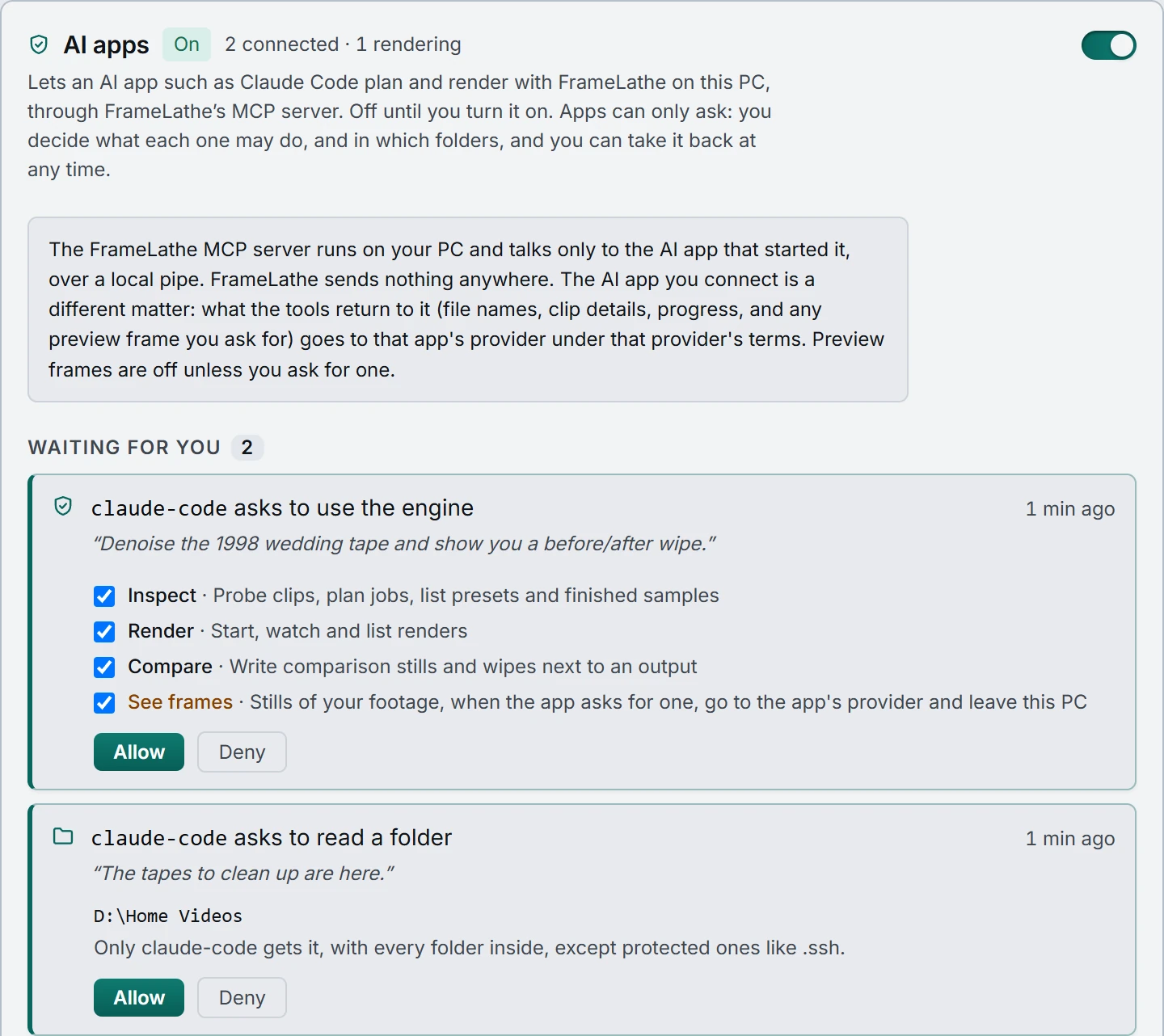
Let an AI app such as Claude Code plan and render with FrameLathe on your PC, through FrameLathe's MCP server. Off until you turn it on; every grant and always-allow rule is yours to give and take back.
FrameLathe includes an MCP server, the standard way an AI app talks to a program on your computer. With it on, an AI app that can start a local MCP server (Claude Code and Cursor are two) can look at your clips, plan a job, render it, check the result and compare it with the source, the way you would in the app.
It is off until you turn it on in Settings → AI apps.
What goes where
The FrameLathe MCP server runs on your PC and talks only to the AI app that started it, over a local pipe. FrameLathe sends nothing anywhere. The AI app you connect is a different matter: what the tools return to it (file names, clip details, progress, and any preview frame you ask for) goes to that app’s provider under that provider’s terms. Preview frames are off unless you ask for one.
So the rest of What leaves the machine still holds for FrameLathe itself. What your AI app does with what it is told is set by that app and its provider, not by FrameLathe.
Turn it on and connect an app
- Open Settings → AI apps and turn it on. A one-line version of the note above shows when you do; the full note is under How it works.
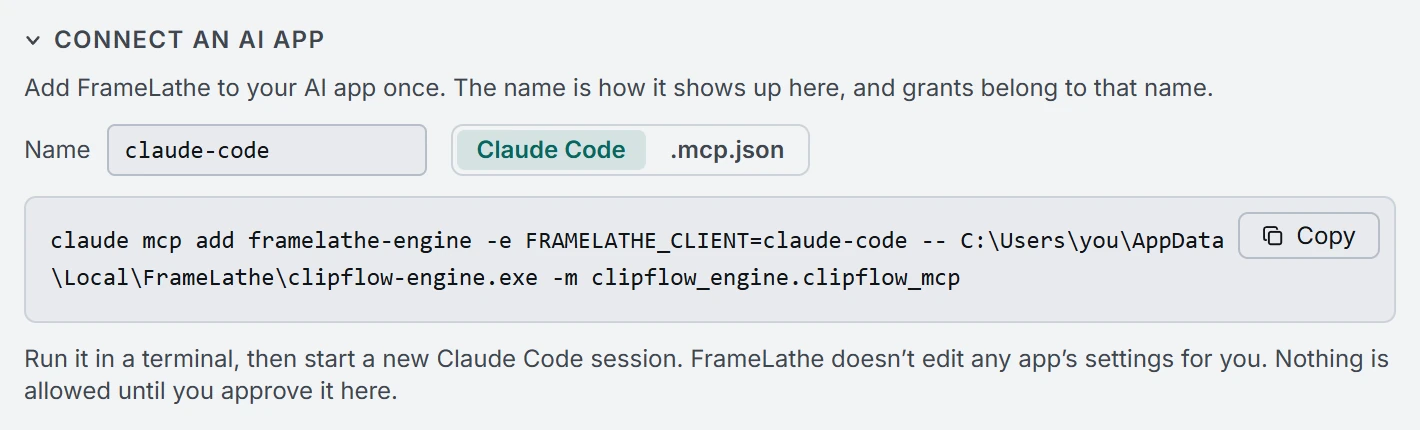
- Open Connect an AI app. Pick a name for the app (it is how the app shows up in the list, and its permissions belong to that name), then choose Claude Code for a terminal command or .mcp.json for a settings block.
- Copy it into your AI app. The command names the FrameLathe engine by its full path on your PC. FrameLathe does not edit any app’s settings for you.
- Restart the AI app. Nothing is allowed yet: its first request appears in the section for you to answer.
That first request is when you choose what the app may do. Nothing is granted up front, and until an app asks, the section shows an example request so you can see what answering looks like.
What an app can ask for
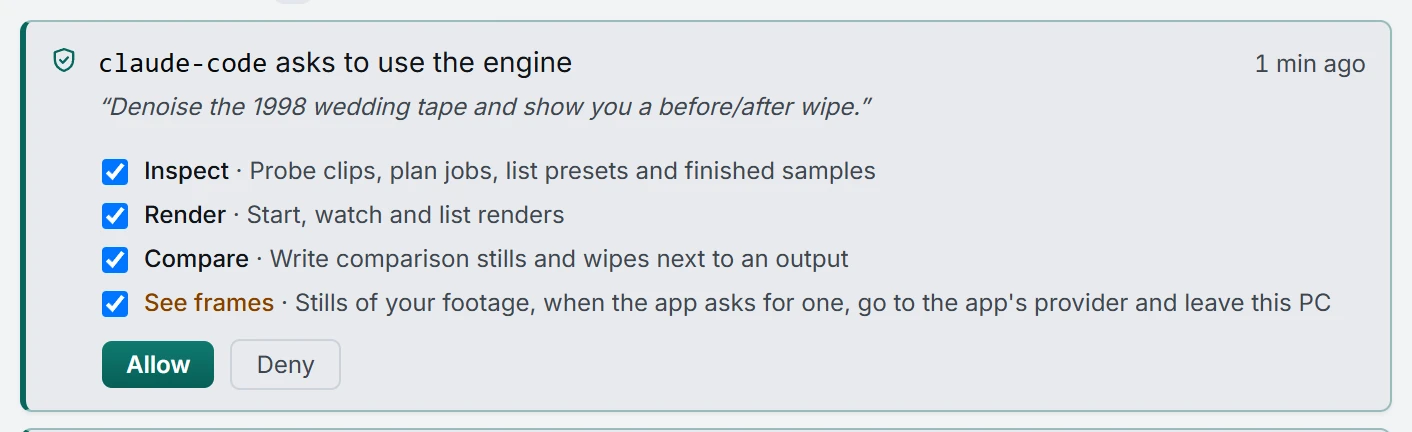
An app can only ask. It cannot answer its own request or widen what it holds. Each request appears under Waiting for you, with the app’s reason, and a toast and a count on Settings show it wherever you are in FrameLathe. You can untick any permission before you allow it.
- Inspect: look at clips (size, frame rate, interlacing), plan a job and its time and disk cost (with settings such as output height, delivery format, stabilize or face details, and an option to crop a tape’s black capture edges), estimate a whole batch, check what this PC’s graphics card can run, and check that a finished file is what its delivery format promises.
- Render: start, watch, list and cancel renders. A render keeps running if the app restarts, and the app can find it again. A plan says which engine each step will really use; if one would fall back to a lesser one (such as the classic denoise filter when the GPU add-on is not ready), the app is told before anything starts, and the render is refused unless it says to go ahead anyway. While it runs, the app sees what each step ran on and any setting that was ignored.
- Compare: write comparison stills and before/after wipes next to an output, and look for frames where an output drifts from its source.
- See frames: put a still of your footage into the app’s reply. The app has to ask for one each time, and the still goes to the app’s provider with the rest of the reply, so FrameLathe asks you twice before allowing it.
An app also needs a folder before it can open a file: read for sources, write for renders and comparisons. Protected folders such as .ssh are refused. Folder grants belong to the one app that asked.
Always allow (optional)
By default you answer every request. If that gets in the way, you can tell FrameLathe to always allow one app some of it, the way coding tools let you allow a command for good:
- On a request, Always allow opens a panel under it that answers it and lets later requests for the same permissions (or, on a folder request, the same folder) through without asking. A folder request can also be widened to any folder that is not protected.
- On an app’s row under Apps, Always allow sets this up before the app asks: tick permissions, and choose Read any folder or Read + write any folder.
Each rule lasts 1 hour, until FrameLathe restarts, or until you remove it. Before any rule is made, FrameLathe warns you what the app can then do without asking. Two things matter here:
- FrameLathe knows an app only by the name it gives (
FRAMELATHE_CLIENTin the connect command). Nothing checks that name, so any program on your PC can claim to be that app and use its rules. - See frames is never part of a rule unless you tick it, and ticking it asks you a second time, because stills of your footage go to the app’s provider.
Protected folders (.ssh, AppData, FrameLathe’s own data folder, Windows, Program Files, network paths) stay refused under every rule, including any folder. Requests a rule covers are answered at once and still appear in Recent activity. Rules show on the app’s row; Remove ends one, and Revoke or turning AI apps off ends them all.
Watching and stopping
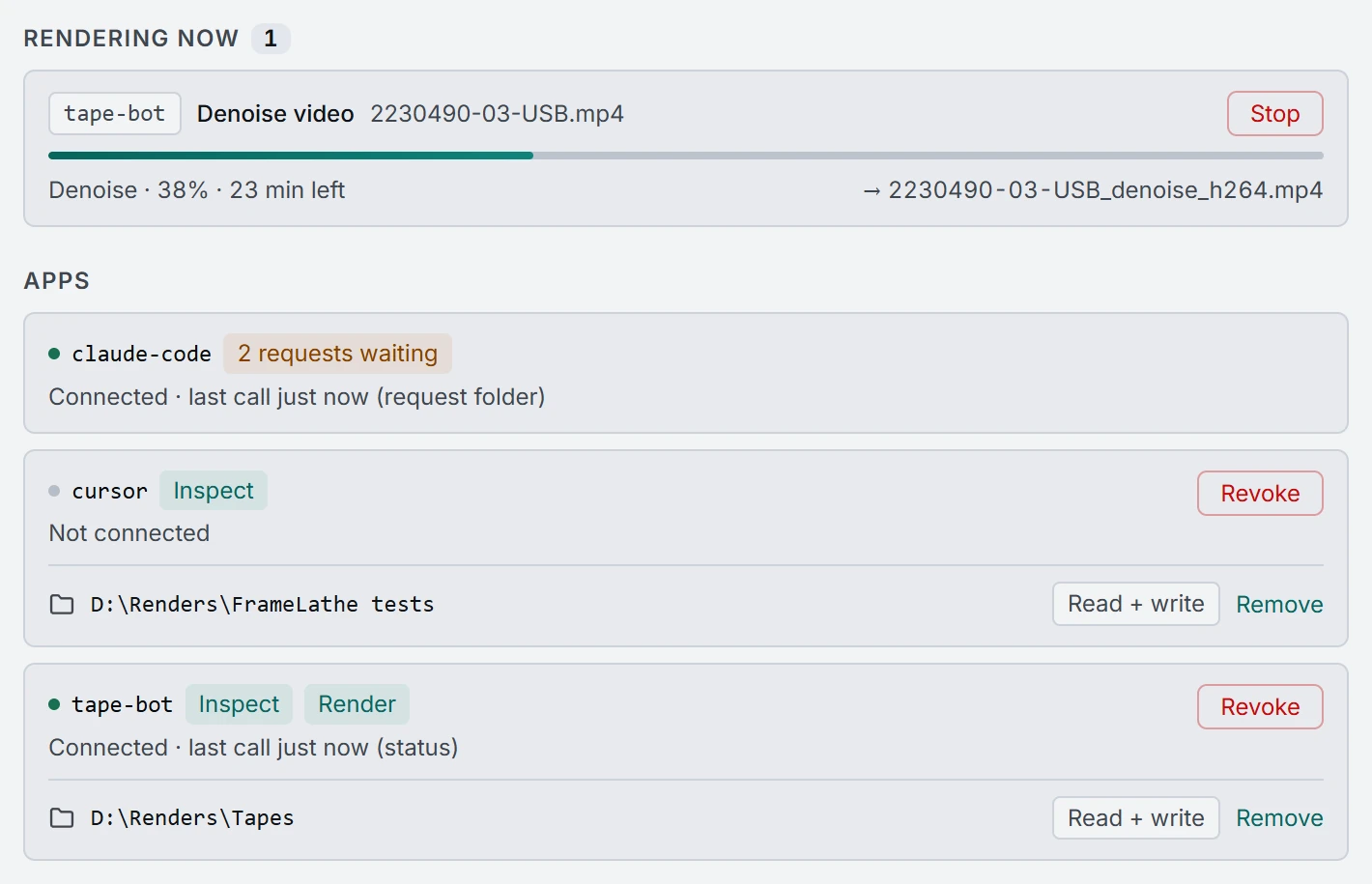
Rendering now lists each app’s renders with progress, time left and a Stop button. Apps lists every app, whether it is connected, its last call, and what it holds; Revoke takes all of it back, rules included, and Remove takes back one folder or one rule. Turning AI apps off refuses every app on its next call, whatever its rules, and stops their renders. Removing a rule a render depends on stops that render too. Recent activity lists every request and decision.
One render at a time
A render from an AI app and a render from the queue (or a preview) do not run at the same time on one graphics card. An app’s render is refused while the queue is rendering, and Start (or a preview) is refused with a message while an app’s render runs. If the queue reaches a clip while an app is rendering, it stops with that clip still waiting; no clip fails because of it. The error page has the message you see.
Licence
Installing a FrameLathe update closes FrameLathe’s engine, including one an AI app is connected to, and cancels a render it was running; reconnect FrameLathe in the AI app afterwards.
Rendering through an AI app needs an activated licence, like Start. Without one, looking at clips and planning still work, and a render reports that a licence is needed.
What it is not
- It is not the assistant on this website. That assistant answers from the published docs and never sees your footage; see What does the website AI assistant know?.
- It is not a sandbox against programs running as you. It keeps a well-behaved AI app inside what you allow.